This part is an extension of Ethan Hein’s challenge. I’m actually quite happy with how the remix turned out given that it was my first attempt! Say Amen did very well on the charts, mainly because it sounds super poppy. When I attened the Sydney leg of the Pray for the Wicked Tour, the audience was an interesting mix. I had the expectation that it would be just like any other pop-punk gigs. You know, a bunch of 20 something year-olds in flannels and skinny jeans. But NO! Surely there were groups of die-hard emo fans, but there were also mainstream fans, and even kids! The rock to pop transition has been a success I’d say.
Layers
DAW
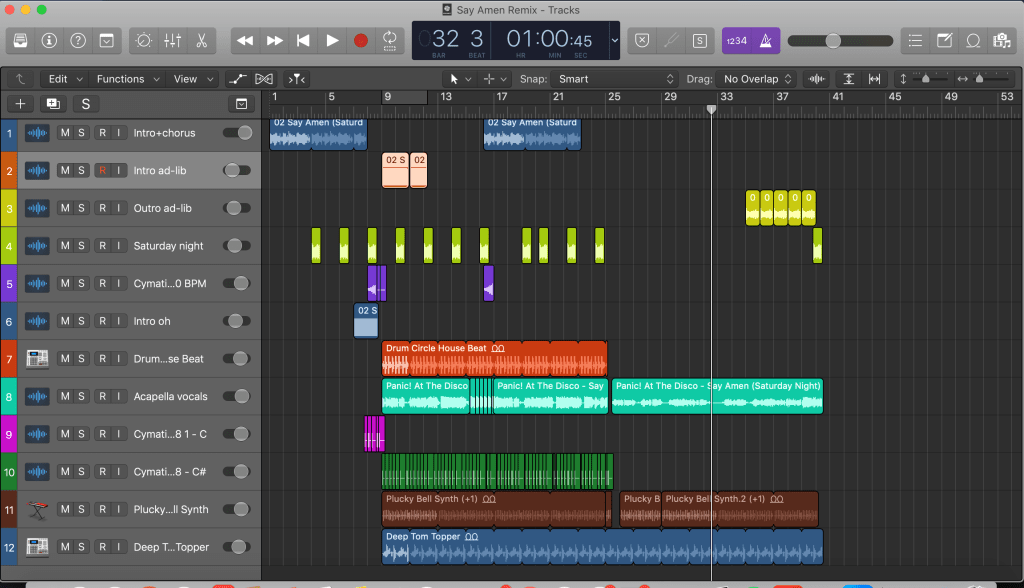
Once again, I worked on LogicPro X. Assigned a colour to each track to make them nice and clear, 12 layers in total. All loops and samples.
Vocal stems
The loops are from the original song (Track 1,2,6), and acapella vocals are from YouTube (Tracks 4&8). It wasn’t the best version but I used it anyway.
808s
This was my first time being so comfortable with 808s. For some reason they always sounded a bit off before this project, so I was reluctant to try them. All availale in the free sample packs by Cymatics.
Drum Loops
I experimented with the house beat (Tarck 12), because I saw my friend doing a house remix of his trap song. It’s not a genre I’m in or trying to get into, but it could be useful one day.
How I Made the Remix?
I’ve sort of developed some steps to stay organised and productive so it was pretty much the same as the Demi Lovato cover I made.
-Find keys, chords, BPM online
-Warp vocals and organise
-Then put 808s in
-Vocal chops+ lots of copying and pasting
-FX
-Put house beats in
-Review
-Shows the class
-Shows producer friends
-Review and keep working
This remix happened quite organically, I didn’t reference anyone’s work at all. But I will definitely explore how to make a good house drop in case anyone asks me to DJ haha
Finished Product
Pedagogical Possibilities
In a classroom setting, I think it’s definitely possible to teach kids how to remix. The only problem with younger ones is that they might struggle a bit with warping. I was thinking I should provide them with stems, and give them the freedom to put in other elements such as midi and make their own loops etc. So my approach would be giving them a “sample pack”, and a chart with basic structure of a song for each task.
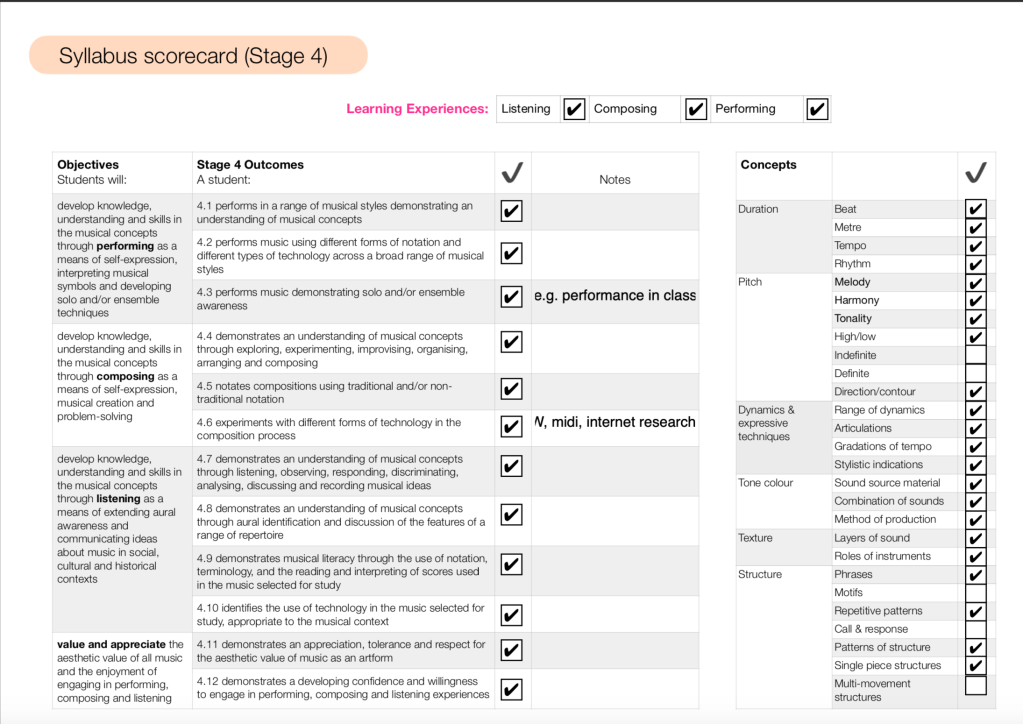
This task would be good training for timing and listening skills because they have to follow the metronome and check whether the loops are in time. Sense of rhythm is very important for musicians. Let’s say I give this task to a stage 4 class, it would tick most boxes in the checklist below-
I had a read of The Dawn of DAW by Adam Patrick Bell (2018), and it inspired me to introduce the DIY concept to students. Children these days have easy access to music technology and it would be a nice idea to integrate that with teaching and learning. There’re resources out there-books, online courses, YouTube tutorials to facilitate that. In fact, there’s a new wave in the music industry called Bedroom Pop, a lo-fi, trendy (vintage) sound that made popular on social media. Artists are mostly self-taught and they can just create music without going out at all. I’m excited to see students take up the producer role and make music they listen to every day.
 Kidz! Music!