Reflections:
On Week 5-Music and Class/Gender/ Everything Else
This week’s lecture was very inspiring. I took a trip down memory lane and realised that there are numerous factors that can impact a person’s achievement in music.
I do agree with Anna that music students, or musicians in general belong in different categories due to different reasons. A family’s socioeconomic status is particularly important, especially when a child wishes to attend private lessons. I was lucky enough to be able to afford private training and tertiary education in music. Performing arts are expensive. Musical instruments, equipments, maintenance, lessons, travel cost. Everything is an investment!
On top of that, students also have to consider whether their financial situations allow them to pursue music full-time. From a financial perspective, the demand for the arts tend to drop when the economy declines, and Covid-19 is a perfect example. Some parents became unemployed and their children are forced to stop taking music lessons. It has a direct impact on music teachers’ income. Live events are being cancelled so musicians struggle to find jobs. This is a time where I understand the hiercharchy of professions in society.

I sometimes wonder what it is like to be a second-generation musician. I get the impression that music is far more accessible and if a child’s parents are active in the arts. They are able to connect with other musicians, which means more work opportunities. The question is how, as music educators, can we assist those with less privileges? How can we open doors for young aspiring musicians?
Music and gender
As a female, I first experienced gender difference during lockdown. I had a deal with a recording studio in the city and I was given time slot for 7pm to 7am every Monday. I was usually in the house by myself since my roommate retreated back to her farm. I started to be worry about my personal safety whenever I had to go to my recording sessions. The streets were empty and eventually I decided to stay home because of lack of support. I could not help but imagine how different it would be for a male in the exact same situation. I would have progressed much quicker if safety was not an issue! On the bright side, though, I realised my room wasn’t too bad for recording after all!
Another phenomenon in modern music is that males seem to be have a bigger interest in music technology. At this point, the music industry is still male-oriented. Can music tech be gender biased? As music technology is such a useful tool to keep records and reach out to an audience. What can educators do to increase the interest of female students?
interesting article I recently came across.
References
https://variety.com/2019/music/news/berklee-college-women-in-music-study-1203161078/
https://theconversation.com/women-in-sound-addressing-the-music-industrys-gender-gap-85132
On Informal Learning
I continue to question whether it is necessary to train in an institution.
Similar to Lucy Green, I felt enlightened when I heard that many popular musicians were self-taught. Coming from a classical background, it is common for teachers to prepare certain pieces for their students and the space to play what they enjoy listening to seems limited. I do have experience with teachers who approached pop music in the same way as classical music. It took away the “fun” because they are two different styles and are created in different ways.
Informal learning in a classroom setting helps students understand concepts like layers and textures. The hands-on and collaborative experience allow them to THINK. Learning material is highly accessible on the internet. Therefore, the impact of situations like covid is smaller for students with experience in informal learning, because of it does not rely on face-to-face teaching as heavily. I also believe that teaching what students like to listen to is a win-win!
Music Teaching with Minimal Verbal Instructions
We got to explore Off-Keetman Schulwerk methods this semester. I noticed that there is something in common across music curriculum 2 and extension-we are taught to use more gestures and demonstrations rather than verbal instructions. Why? Whether it is classroom teaching, choir, school bands. Is it more effective to “chunk”?
To give myself some practice before my placement, I have been experimenting on my 3 and 6 year-old piano students. Before starting this uni, I relied on talking a lot e.g. I would say “[name of student], please play this”/ “please repeat after me” etc. But I have been applying the techniques and I discovered that a lot of verbal instructions were unnecessary (and my voice is happy to get some rest). I was concerned that the 3 year-old might not be able to fully comprehend everything I say, but he certainly has no problem learning through chunking now.
Modernisation of Music Classroom
Something I have learnt in this course so far is that my identity as a musician can actually be applied in our teaching. For instance, methods we adopted to learn music may influence our pedagogy. I choose a modern approach because of my love for popular music. Moreover, I reckon that the world is constantly changing and both students teachers have to KEEP UP. It is crucial, in this ever-changing world, to be fully equipped and competent. That is my aspiration as an educator as well.
I visited my prac school (Sydney Secondary College in Leichhardt) and was told that they have moved all the assessment tasks online! I personally see it as a positive change because it helps students and teachers obtain a new skill. Being able to be a part of online platforms also provides means to communicate with and learn from other musicians. I cannot wait to share my projects with them and write songs together!
My Example of informal leaning/music tech within a classroom–
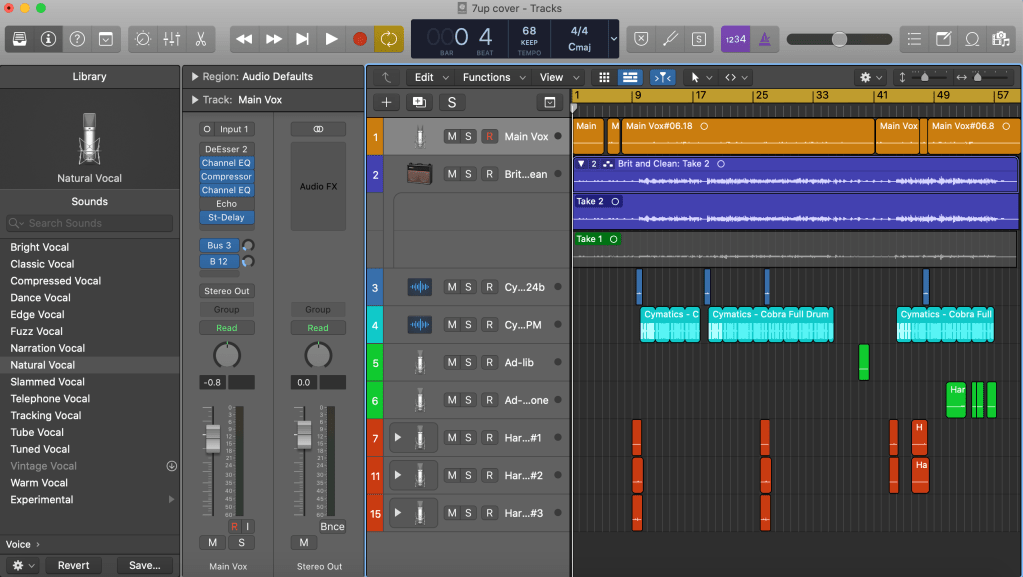
This can be used as a sample for a multimedia assessment task. The sequence would be
-Learn to play a 4-chord song of choice in groups (simple progressions, no barre chords)
-Learn to record and produce on DAW
-Film and edit a video
I chose a song called “7 Up” by Swedish musician Boy in Space. His indie pop/electronic style is very popular amongst young people.
I kept my logic project simple this time to cater beginners. It should be able to cover structure of pop songs, texture, harmony etc.
Behavioural Management in a Music Classroom
I find Jennifer’s lectures more useful than the theories we learnt on main campus because we were actually given scenarios and strategies to handle behaviours. Even though my own teachers in high school exclusively used punitive measures, I strongly believe that there are better ways to achieve the outcomes we are looking for.
I am hoping to observe what my supervising teacher does to manage behaviour and help students to focus on tasks. It is something that I would like to master since I always find it difficult to capture children’s attention. Overall, my goal is to be inclusive and to make sure every student gets to participate in musical activities. I hope the repertoire I selected helps.
Cultural Diversity
What is culture?
It can be the ideas, customs and social behaviour of a group or society. Therefore, it is not limited by particular geographical locations.
I do realise that mainstream music is becoming more inclusive. Mainly because of k-pop, increasing cultural awareness, globalisation etc… If we look at the top50 charts nowadays, it is easy to find music by artists coming from non-Western countries. The elements they brought to the table are culturally diverse. For instance, ‘IDOL’ by kpop group BTS features traditional Korean Pansori Rhythm and instruments kkwaenggwari (brass gong), gakgung (horn bow), and janggu (traditional drum).
The mainstream success of Latin music in recent years also makes it easier to introduce students to South American culture and musical features e.g. claves
As someone interested in cultural diversity, I am glad that the general public are open to music from foreign backgrounds. Having a diverse list of repertoire can definitely help students learn culture and even languages through music. Especially in a culturally diverse city like Sydney, representation is so important to children coming from all heritages.
Reference
A 21st century music educator-my manifesto
My first year of MTeach is coming to an end. I am surprised by how hands-on and creative music education can be. However, due to Covid-19 restrictions, students are not allowed to touch instruments at school. I will not get to observe the practical side of teaching and learning (other than computer work). but it still inspired me to think about who I am and what kind of educator I would like to be.
When it comes to music education, my hometown Hong Kong has a music syllabus that includes everything we are told not to do. Students are given a lot of worksheets and usually only get to learn songs from textbooks or choir repertoire. Back in 2015, the year I graduated from high school, only 200 out of 74,131 candidates sat the music exams. The irony is private music education has always been popular.
Therefore, it was mind-blowing when we were encouraged to teach through music technology because I never imagined it would work in a school setting. I, as a pop musician, being allowed bring in new ideas into a classroom is NEW and exciting. I have come up with a few points I would like to explore in my professional experience-
-after my first day in prac, I had two main observations
a) worksheets are still quite common
b)students are not fully engaged and therefore teachers put in more effort than needed (theoractically) to get children’s attention.
I am hoping I have the chance to create an environment in which I can rely on minimal verbal instructions (and written work with colouring-ins). Less talking, more musicking, basically. AND NO LABELLING SONGS AS “GOOD” OR “BAD”.
–balancing the old and the new
Music Theory may seem “boring” but it builds a foundation for better understanding and composition. I will definitely incorporate theories into practical tasks i.e. let them HEAR.
–What do I bring into the classroom?
Music technology
🌟a selection of pop music in various styles to ENGAGE
🌟teaching chord-playing instruments and simple music production to:
🌟give them a sense of achievement
🌟encourage them to share the music THEY LIKE and help them understand musical concepts through it
🌟provide ways to present their work to the world (to CONNECT) whether it is live performances or video making
🌟work collaboratively
🌟Cultural diversity for EXPOSURE
My supervising teacher thinks that my approach might only be applicable to private schools. Nevertheless, these activities can actually be done with limited resources. Music can inspire people in so many ways, and I hope that my teaching will do the same.

Reference
Kallio, A. (2017). Popular “problems”: Deviantization and teachers’ curation of popular music. International Journal of Music Education, 35(3), 319–332. https://doi.org/10.1177/0255761417725262
 Kidz! Music!